October 2026 was a month of factories and hiring plans more than contracts. Blue Origin announced Constellation Park, a 1.3M sq. ft. satellite manufacturing campus in Hutto, Texas, expected to create more than 2,000 jobs, and a $330M expansion on Florida’s Space Coast to build New Glenn upper stages at a higher rate. Lockheed Martin Space plans up to 1,250 new jobs in Colorado, and CesiumAstro announced a 100-job facility in Melbourne, Florida.
On the funding side, Xona Space Systems raised a $250M Series D to scale its navigation constellation, Czechoslovak Group became MDA Space’s largest shareholder with a 9.5% stake, and Infinite Orbits, Fortastra, Kapta Space, and Rendezvous Robotics closed rounds.
In Europe, ESA ordered four more Galileo Second Generation satellites from Thales Alenia Space and Airbus. In the U.S., the FCC authorized SpaceX’s 15,000-satellite direct-to-device system, approved Amazon’s acquisition of Globalstar, and proposed new direct-to-device rules, while the FAA published five proposals to streamline Part 450 launch licensing. Meanwhile, Aetos Systems plans to cut up to 126 jobs at Kennedy Space Center as NASA brings that work in-house.
Top 7 Hiring Signals
Blue Origin Plans a 2,000-Job Satellite Campus in Hutto, Texas
On October 8, Blue Origin announced Constellation Park, a 1.3M sq. ft. campus in Hutto to manufacture satellites, solar arrays, avionics, and telecom hardware for its TeraWave constellation, with more than 2,000 manufacturing and related jobs expected over the next ten years. It adds a long-term manufacturing and engineering pipeline to Blue Origin’s existing Texas workforce.
Lockheed Martin Space to Add Up to 1,250 Jobs in Colorado
Lockheed Martin Space plans to add up to 1,250 jobs over the next four years at its existing facilities in Douglas and Jefferson counties. The state lists cybersecurity engineers, software engineers, technicians, and administrative staff among the roles.
Blue Origin Invests $330M on Florida’s Space Coast
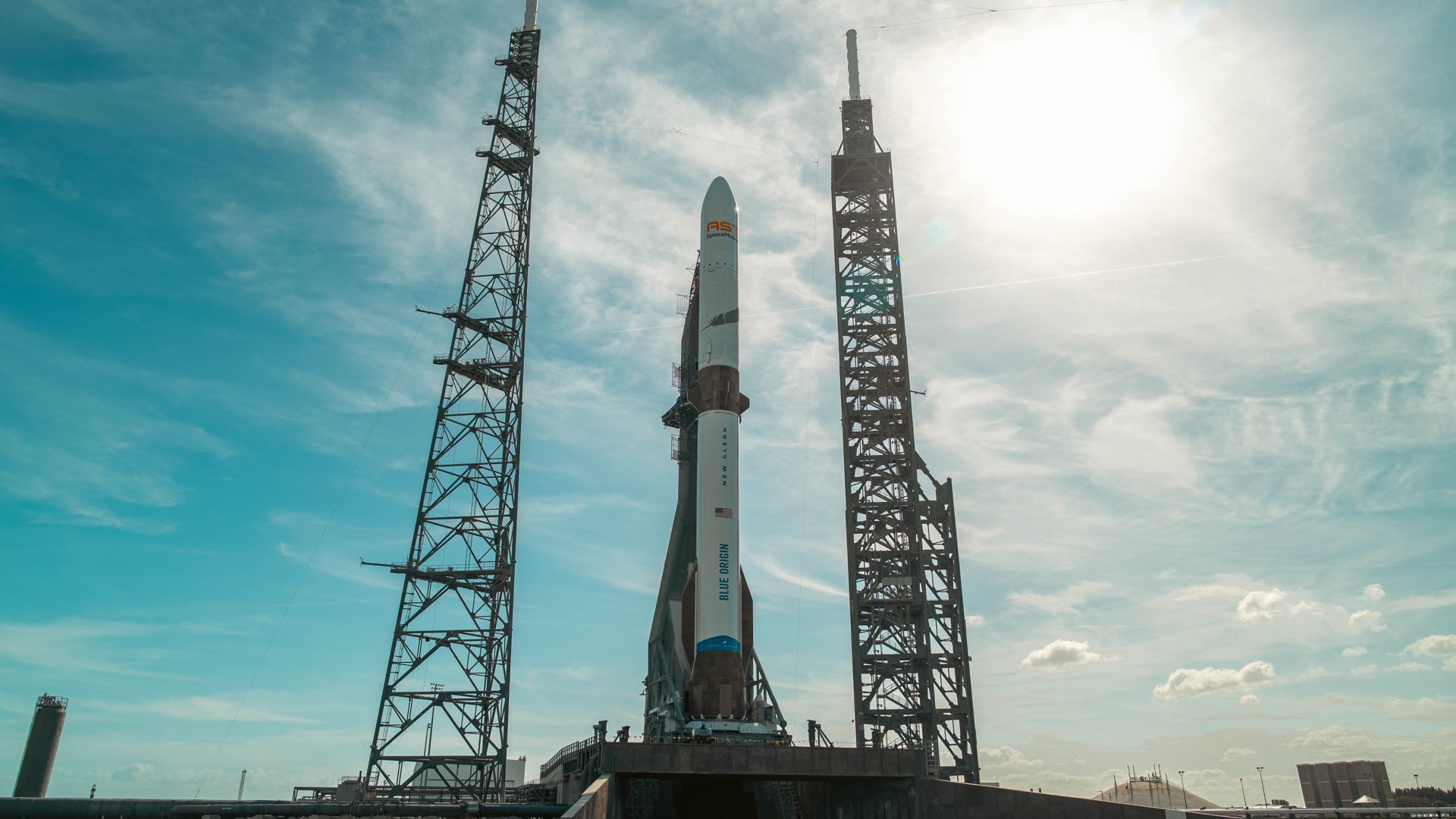
Blue Origin detailed a $330M expansion of its Rocket Park facilities near Kennedy Space Center to build up to 150 New Glenn 9×4 upper stages a year, with completion targeted for summer 2027. The buildout points to hiring in production, test, facilities, and launch-site operations as Blue Origin works toward New Glenn’s return to flight.
FCC Authorizes SpaceX’s 15,000-Satellite Direct-to-Device System
The FCC granted SpaceX authority on October 6 for a very-low-orbit direct-to-device system of about 15,000 satellites using spectrum it is acquiring from EchoStar, with half due in orbit by 2032. Deployment at that scale keeps RF engineering, network operations, carrier integration, and spectrum work in demand.
Xona’s Series D, led by Future Ventures at a $2.45B valuation, will fund scaled-up manufacturing and more satellite deployments for its Pulsar navigation constellation, with four spacecraft set to begin serving customers in 2027. Hiring needs center on satellite production, navigation payload engineering, and constellation operations.
CesiumAstro Picks Melbourne, Florida, for a 100-Job Facility
CesiumAstro selected Melbourne, Florida, for a $25M engineering and manufacturing facility that is expected to create 100 jobs over the next 12 months. It adds phased-array, RF, and production hiring on the Space Coast alongside the company’s Texas headquarters.
ESA Orders Four More Galileo Second Generation Satellites
ESA extended its contracts with Thales Alenia Space and Airbus Defence and Space to build two more Galileo Second Generation satellites each, bringing the program to 16 satellites; the four new ones are due for delivery in 2031. The orders add production and test work at both primes in Italy and Germany.
MDA Space (Canada) – Czechoslovak Group bought a 9.5% strategic stake, becoming the largest shareholder (October 13). Cooperation could include co-investing in manufacturing or assembly facilities in Europe. Source.
Xona Space Systems (United States) – Series D, $250M (October 22). Scaling manufacturing and deploying more satellites for the Pulsar navigation constellation. Source.
Infinite Orbits (France) – Equity raised in two tranches, €52M (October 19). In-orbit servicing, with four launch slots on Impulse Space transfer vehicles booked through 2029. Source.
Fortastra (United States) – Series A, $30M (October 8). Maneuverable spacecraft for on-orbit security. Source.
Kapta Space (United States) – Series A, $24M (October 9). Scaling production of its spaceborne radar payloads, qualifying them for flight, and preparing a first orbital demonstration; the company also reports multiple classified moving-target indication (MTI) contracts. Source.
Rendezvous Robotics (United States) – Seed, $20M (October 28). Self-assembling modular spacecraft, with a low-Earth-orbit demonstration planned no earlier than April 2028. Source.
Foundational (United Kingdom) – Pre-seed, £8.2M (October 1). Automated satellite laser ranging: retroreflectors, ground stations, and a data platform. Source.
Satlyt (United States) – Seed, $8M (October 1). Software for running AI and data processing on board satellites; the round funds larger engineering and customer-delivery teams. Source.
WarpWare (United States) – Pre-seed, $1.2M (October 19). AI engineering tools for spacecraft flight software. Source.
Contracts and Grants
ESA → Thales Alenia Space (Italy) and Airbus Defence and Space (Germany) – value undisclosed (October 27). Two more Galileo Second Generation satellites each, bringing the program to 16. Read more.
Thales Alenia Space / IRIS² → MDA Space (Canada) – over C$100M authorization to proceed (October 30). AURORA digital phased-array antennas and antenna controllers for the first 66 IRIS² satellites, subject to contract finalization. Read more.
U.S. Space Force → York Space Systems (Denver, CO) – value undisclosed. Two previously awarded Space Data Network task orders, announced October 12, including Phase A work on an on-orbit Space Exchange Point demonstration. Read more.
U.S. Space Force / Space Systems Command → BAE Systems (Falls Church, VA) – value undisclosed (October 15). Development and demonstration of ultra-compact RF terminals for the space data layer. Read more.
Expansions and Layoffs
Blue Origin (Hutto, TX) – Constellation Park, a 1.3M sq. ft. satellite manufacturing campus, 2,000+ jobs over ten years (October 8). Read more.
Lockheed Martin Space (Colorado) – Expansion at existing facilities in Douglas and Jefferson counties, up to 1,250 jobs over four years (October 9). Read more.
Blue Origin (Merritt Island, FL) – $330M Rocket Park expansion for New Glenn upper-stage production (October 16). Read more.
CesiumAstro (Melbourne, FL) – $25M engineering and manufacturing facility, 100 jobs over the next 12 months (October 16). Read more.
Agile Space Industries (Bellevue, WA) – New Seattle-area engineering office, growing to 20–30 engineers (October 15). Read more.
Aetos Systems (Kennedy Space Center, FL) – Up to 126 jobs cut in December as NASA brings AEGIS contract work back in-house (WARN notice, October 16). Read more.
Launch and Regulation
FCC / SpaceX (United States) – Authorization for a ~15,000-satellite direct-to-device system (October 6), with milestones of 50% in orbit by 2032 and 100% by 2035. Read more.
FCC / Amazon Leo (United States) – Approval of Amazon’s $11.57B acquisition of Globalstar (October 27). Read more.
FCC (United States) – Proposed modernized direct-to-device rules, exploring up to 482 MHz of additional spectrum for satellite-to-cellular service (October 29). Read more.
FAA (United States) – Five proposed rules to streamline Part 450 launch licensing, including electronic application submission and a lightning-hazard exception, published October 5 with comments due November 4. Read more.
NASA / SpaceX Crew-13 (United States) – Crewed launch to the ISS (October 1). Read more.
JAXA / MMX (Japan) – An H3 launched the Martian Moons eXploration sample-return mission to Phobos (October 19 UTC, October 20 in Japan). Read more.
Rocket Lab / Neutron (United States) – Neutron’s first launch moved from late 2026 to 2027 (October 14); CEO Peter Beck pointed to voids found in a composite tank dome. Read more.
Roles in Demand, October 2026
Engineering
Satellite systems engineering
RF & phased-array engineering
Navigation payload engineering
Radar engineering
Robotics & autonomy
Integration & test engineering
Manufacturing & Operations
Satellite production
Launch vehicle production
Manufacturing engineering
Launch-site operations
Constellation operations
Software & Analysis
Flight software
Network operations
Onboard AI & edge compute
Space data network engineering
Compliance & Assurance
Spectrum & licensing
Launch licensing (Part 450)
Quality engineering
Mission assurance
Security / cleared program support
Key Regions
Texas (U.S.)
Florida (U.S.)
Colorado (U.S.)
California (U.S.)
Washington (U.S.)
Canada
Italy
Germany
France
Ready to take the next step?
Whether you're hiring or looking, we connect you with the space industry.
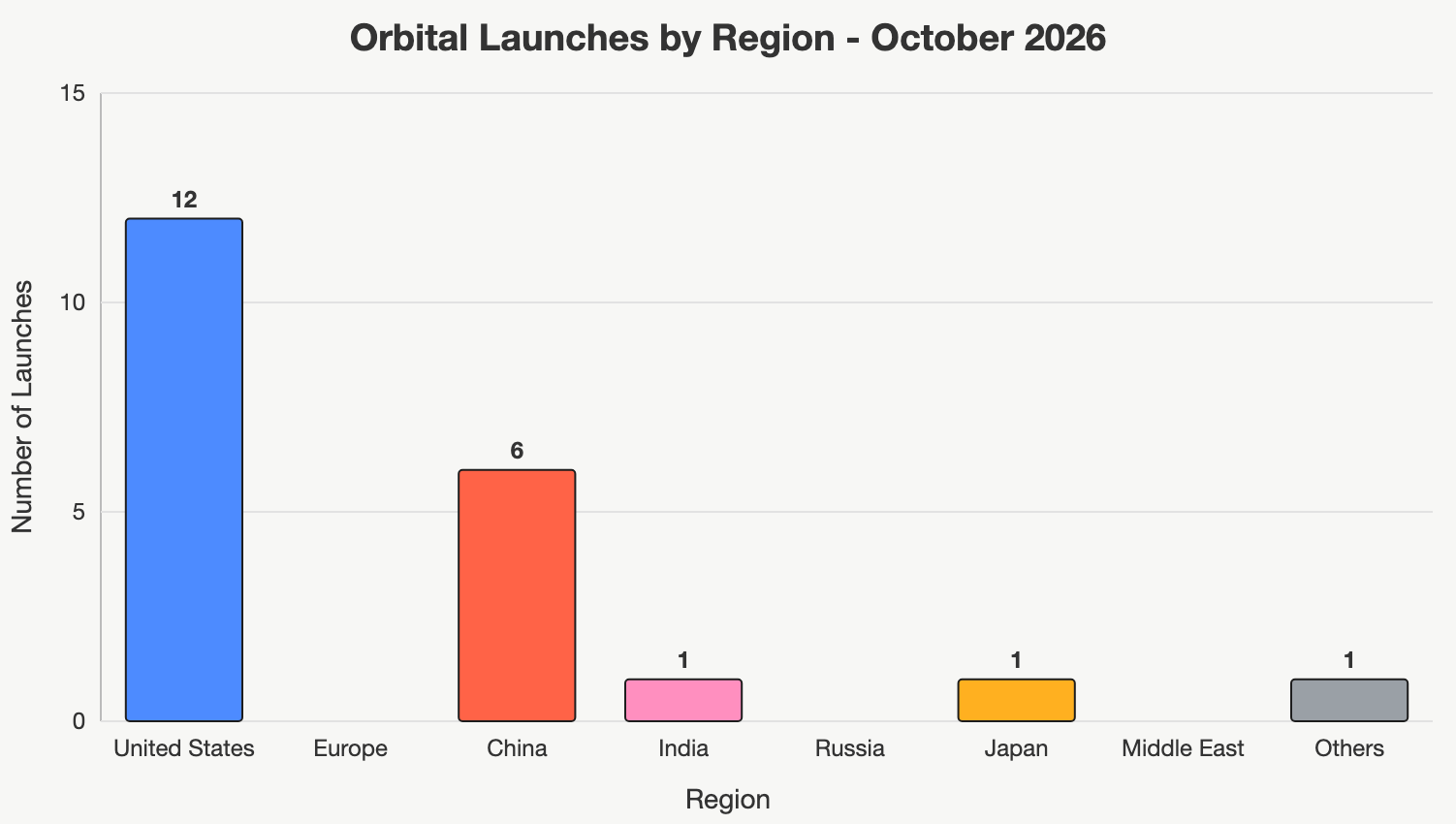
This bar chart visualizes orbital launch activity for October 2026, with a total of 21 attempts,
all successful. The United States led with 12 launches: 10 Falcon 9 flights (4 Starlink batches,
Crew-13, CRS-35, Transporter-18, Bandwagon-5, an SDA Tranche 1 Tracking Layer batch, and a
Starshield mission), a Falcon Heavy carrying NROL-97 for the NRO, and a Rocket Lab Electron with
HawkEye 360 satellites. China contributed 6 launches, including 2 Guowang batches and a Ceres-1S
sea launch. Japan launched the MMX Phobos sample-return mission on an H3, India launched the
NVS-03 navigation satellite on a GSLV, and South Korea flew Nuri for the fifth time. Europe, Russia,
and the Middle East had no orbital launches this month.
Methodology and Sources
This report compiles October 2026 announcements from
Payload,
European Spaceflight,
SpaceNews,
FCC,
FAA, and
ESA STAR.
Events are scored on a five-point scale for expected hiring impact within 3 to 12 months.
Rankings weigh funding size, contract value, immediacy, and regional scope.
If you notice any discrepancies or missing information, please contact us at
team@spacejobsearch.com.

 Credit: Blue Origin