July 2026 was led by national security launch and satellite demand. Space Systems Command raised the National Security Space Launch Phase 3 Lane 1 ceiling to $17B across seven providers, after adding Impulse Space and Relativity Federal to the pool, and the Space Development Agency awarded L3Harris and Sierra Space about $1.75B for 36 missile warning and tracking satellites. Space Systems Command also set a goal of hiring around 100 civilians a month to rebuild its acquisition workforce.
Private capital stayed active. K2 Space raised a $500M Series D at a $6.8B valuation to ramp large satellite production in Torrance, and Venus Aerospace, SWISSto12, and China’s Hongqing Technology closed sizable rounds. MDA Space agreed to acquire a majority of France’s CLS, while ICEYE and Redwire opened new operations in Germany and Indiana.
On the regulatory side, the FCC replaced its Part 25 satellite licensing rules with a new Part 100 framework, and the FAA proposed waiving 13 environmental statutes for launch licensing. New launchers also arrived: China recovered an orbital booster for the first time on the Long March 10B debut, and Skyroot’s Vikram-I became India’s first private rocket to reach orbit. No significant space-sector layoffs were publicly reported this month.
Top 7 Hiring Signals
K2 Space Raises a $500M Series D
K2 Space’s Series D, co-led by Kleiner Perkins and ICONIQ at a $6.8B valuation, takes its total funding above $1B and is aimed at ramping production of large, high-power satellites at its Torrance factory, which is sized for up to 100 satellites a year. That points to sustained hiring in manufacturing, integration and test, power and propulsion engineering, and program delivery in Southern California.
NSSL Lane 1 Ceiling Rises to $17B Across Seven Providers
On July 17, Space Systems Command added $11.4B to the National Security Space Launch Phase 3 Lane 1 contract, raising the ceiling to $17B and the estimated mission count from about 60 to about 170. The seven providers are SpaceX, ULA, Blue Origin, Rocket Lab, Stoke Space, Relativity Federal, and Impulse Space, the last two added on July 7. More missions mean steady demand in launch engineering, mission integration, mission assurance, and supplier quality.
SDA Awards $1.75B for 36 Missile Tracking Satellites
The Space Development Agency awarded L3Harris ($955M) and Sierra Space ($798M) agreements to build 36 missile warning and tracking satellites for launch by the end of 2028, supporting Golden Dome. Accelerated schedules like this drive hiring in satellite production, infrared payload engineering, integration and test, and cleared program roles.
Space Systems Command described a push to hire about 100 civilians a month, prioritizing contracting and cybersecurity, after its civilian workforce fell from about 2,900 to 2,500. For candidates in contracts, program control, cyber, and technical acquisition support, it is one of the clearest public-sector hiring signals of the year.
FCC Replaces Part 25 With a New Part 100 Framework
On July 22, the FCC unanimously adopted its Space Modernization order, moving satellite licensing from Part 25 to a new Part 100 “licensing assembly line” and dropping most surety bonds. Operators and suppliers will need people who connect engineering and regulatory work as filings and milestone rules change.
China’s Long March 10B debuted on July 10 and its first stage was caught on a sea platform, the country’s first orbital booster recovery. On July 18, Skyroot’s Vikram-I became India’s first private rocket to reach orbit. New vehicles entering service widen demand for propulsion, recovery, avionics, and launch operations talent, especially in Asia.
Venus Aerospace Raises $91M to Produce Detonation Engines
Venus Aerospace’s $91M Series B, led by Mercury Fund with Lockheed Martin Ventures participating, is aimed at taking its rotating detonation rocket engine from flight demonstration into production for defense and space applications. That points to hiring in propulsion engineering, test, manufacturing, and systems roles in Houston.
K2 Space (United States) – Series D, $500M (July 30) at a $6.8B valuation. Ramps production of large, high-power satellites in Torrance. Source.
Hongqing Technology (China) – Pre-Series B, RMB 1.3B+ (~$191M) (July 2). Satellite manufacturing for the Honghu-3 constellation. Source.
Venus Aerospace (United States) – Series B, $91M (July 8). Moves its rotating detonation rocket engine into production. Source.
SWISSto12 (Switzerland / Europe) – Series C, $70M (July 16). Scales manufacturing of its HummingSat small geostationary satellite against a backlog above $500M. Source.
Linjie Hangtian (China) – Angel round, RMB 200M (~$29.5M) (July 16). Liquid rocket engine development, hot-fire testing, and test and production capacity. Source.
Flexell Space (South Korea) – Series A, $20M (July 14). Equipment and pilot-line upgrades ahead of mass production after 2028. Source.
Outlier Space (New Zealand) – Pre-seed, $7.35M (July 28). Reusable return capsules for microgravity research, with plans to expand the team. Source.
Ravee Optics (United States) – Seed, $6M (July 13). Engineering and in-space testing of compact laser communication terminals. Source.
MDA Space → CLS (Canada / France) – Acquisition of about 70%, €567M (July 8). Adds AI-driven Earth observation analytics and about 1,200 staff. Source.
Mitsubishi Electric → Infostellar (Japan) – Acquisition, undisclosed (July 2). Expands the StellarStation ground-station network. Source.
Contracts and Grants
U.S. Space Force / Space Systems Command → 7 launch providers (U.S.) – +$11.4B, to a $17B ceiling (July 17). NSSL Phase 3 Lane 1 for an estimated 170 missions. Read more.
Space Development Agency → L3Harris and Sierra Space (U.S.) – ~$1.75B (July 14). 36 missile warning and tracking satellites for launch by the end of 2028. Read more.
U.S. Space Force / Space Systems Command → Impulse Space and Relativity Federal (U.S.) – On-ramp to NSSL Phase 3 Lane 1 (July 7), with Impulse becoming the first upper-stage prime. Read more.
U.S. Space Force / Space Systems Command → Raytheon, SciTec, and WildStar (U.S.) – $423.4M combined (July 17). Digitization of ground-based early-warning radars supporting missile warning. Read more.
Space Development Agency → General Dynamics Mission Systems (Scottsdale, AZ) – up to $400.4M (July 24). Tranche 3 ground segment for the Proliferated Warfighter Space Architecture. Read more.
Space Rapid Capabilities Office → Modern Technology Solutions (Alexandria, VA) – $371.3M (July 24). Systems engineering and technical assistance through 2031. Read more.
Space Acquisition and Integration → Sigmatech (Huntsville, AL) – $108.9M (July 17). Systems engineering and technical assistance through 2031. Read more.
U.S. Space Force / Space Systems Command → Lockheed Martin Services (Colorado Springs, CO) – up to $105M (July 7). GPS control-segment changes to operate GPS IIIF satellites. Read more.
NASA Kennedy Space Center → Kiewit Infrastructure South (Florida) – up to $90.3M (July). New underground duct banks and electrical distribution at KSC. Read more.
ESA → Airbus Defence and Space (Europe) – value undisclosed (July 2). Design and build of the Aeolus-2 wind-sensing satellite with EUMETSAT. Read more.
Expansions and Layoffs
Space Systems Command (U.S.) – Civilian acquisition hiring push targeting ~100 hires a month, with priority on contracting and cyber (July). Read more.
ICEYE (Berlin and Munich, Germany) – Launched ICEYE Germany, covering component manufacturing, software, an AI center, and an intelligence group (July 8). Read more.
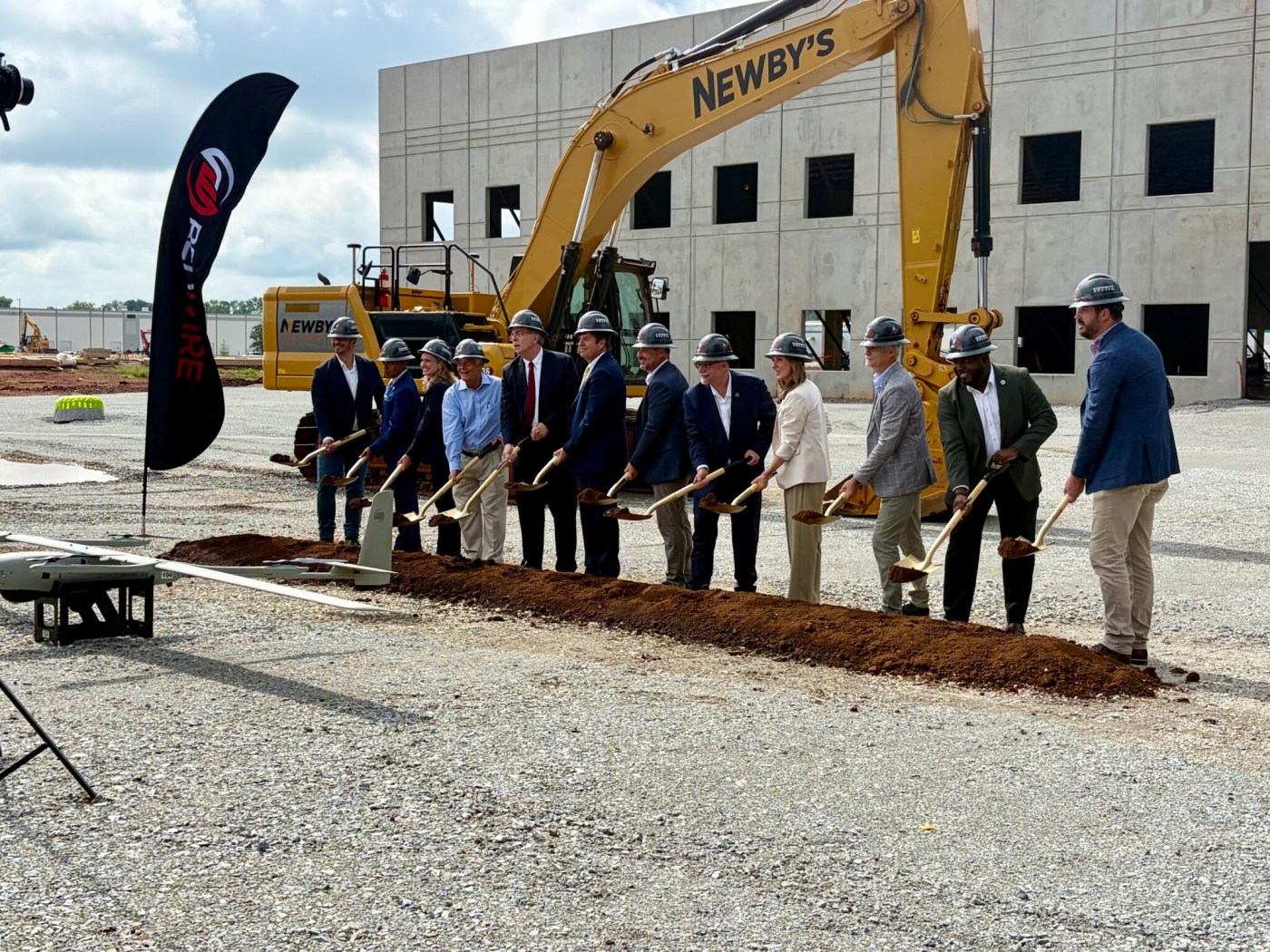
Redwire (Georgetown, IN) – Opened a 30,000 sq. ft. microgravity research and payload facility with labs and an ISS payload operations center (July 20). Read more.
Dish (United States) – Satellite TV and wireless businesses filed for Chapter 11 (July 1), a downside risk for satellite broadcast operations roles. Read more.
Launch and Regulation
FCC (United States) – Space Modernization order adopted (July 22), replacing Part 25 satellite licensing with a new Part 100 framework and dropping most surety bonds. Read more.
FAA / DOT (United States) – Proposed rule to waive 13 mostly environmental statutes for launch and reentry licensing (July 28), with a 30-day comment period. Read more.
FAA / SpaceX (United States) – Starship Flight 12 mishap investigation closed with four corrective actions (July 13), clearing Flight 13. Read more.
SpaceX / Starship Flight 13 (United States) – Second Starship V3 flight (July 24) deployed 20 Starlink V3 simulators and made its softest splashdown yet. Read more.
CASC / Long March 10B (China) – Maiden flight with a sea-platform catch of the first stage (July 10), China’s first orbital booster recovery. Read more.
Skyroot Aerospace / Vikram-I (India) – India’s first private orbital launch succeeded on its maiden flight (July 18). Read more.
Northrop Grumman / DARPA (United States) – The Mission Robotic Vehicle launched with three Mission Extension Pods for geostationary satellite servicing (July 21). Read more.
NASA / Katalyst (United States) – The final Pegasus XL flight launched Katalyst’s LINK spacecraft to capture and reboost NASA’s Swift observatory (July 3). Read more.
ULA / Amazon Leo (United States) – The final Atlas V launch for Amazon Leo added 29 satellites (July 2) as Amazon moves to Vulcan. Read more.
Roles in Demand, July 2026
Engineering
Spacecraft systems engineering
Propulsion engineering
Infrared & sensor payloads
Launch vehicle & recovery engineering
Robotics & servicing
Integration & test engineering
Manufacturing & Operations
Satellite production
Launch operations
Mission integration
Payload operations
Supplier quality
Software & Analysis
Ground segment software
Cybersecurity
Earth observation analytics
Systems engineering & technical assistance
Compliance & Assurance
Contracting & acquisition
Spectrum & licensing (Part 100)
Environmental & launch licensing
Mission assurance
Security / cleared program support
Key Regions
Southern California (U.S.)
Colorado (U.S.)
Texas (U.S.)
Arizona (U.S.)
Alabama (U.S.)
Indiana (U.S.)
Germany
Switzerland
France
China
India
South Korea
Ready to take the next step?
Whether you're hiring or looking, we connect you with the space industry.
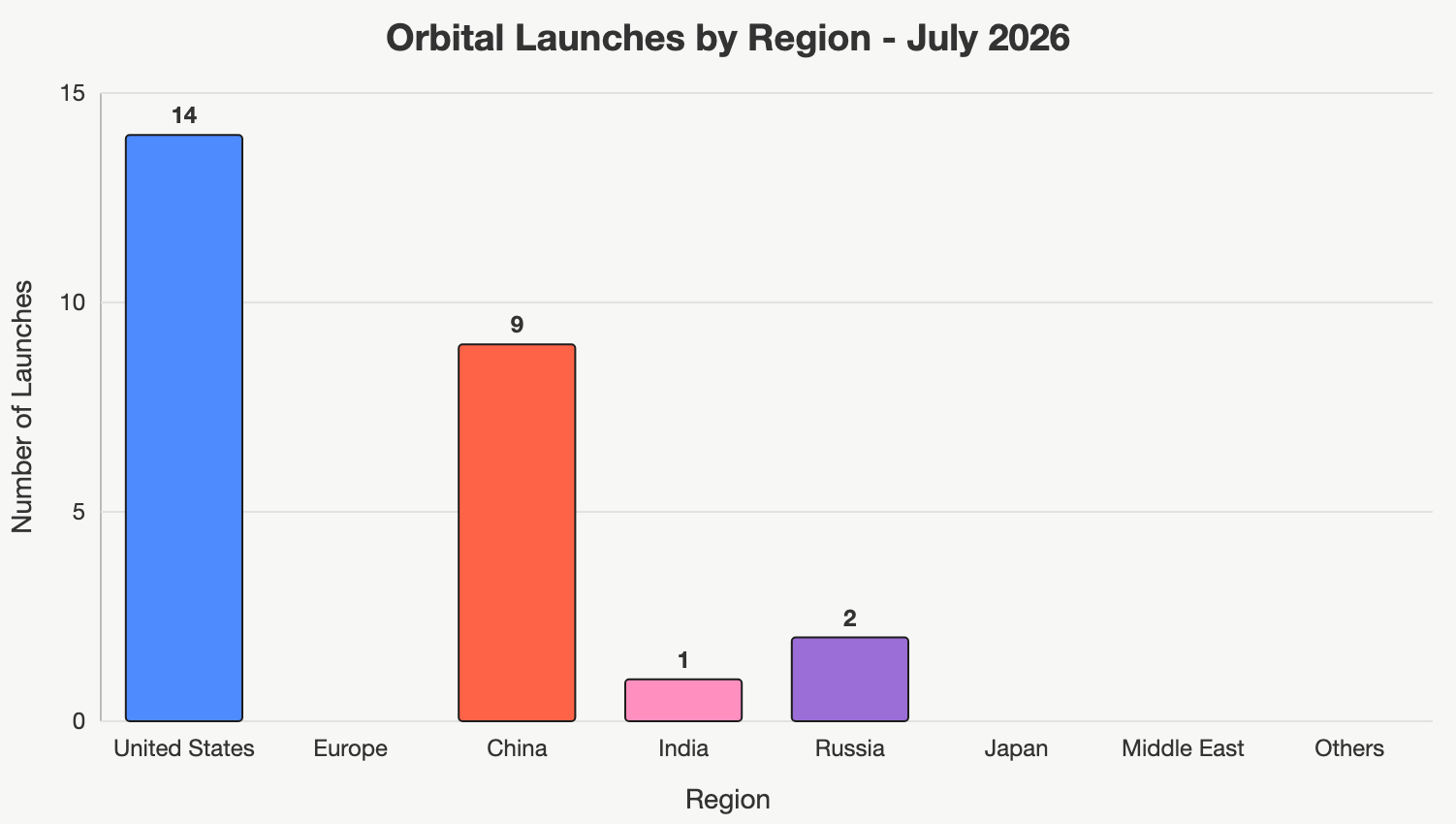
This bar chart visualizes orbital launch activity for July 2026, with a total of 26 attempts, all
successful. The United States led with 14 launches: 12 Falcon 9 flights (8 Starlink batches,
Transporter-17, an SDA Tranche 1 Transport Layer batch, Northrop Grumman's Mission Robotic Vehicle,
and NROL-95), the final Atlas V launch for Amazon Leo, and the final Pegasus XL with Katalyst's
LINK spacecraft. Rocket Lab flew no Electron missions this month. China contributed 9 launches,
including the Long March 10B debut and its first stage recovery and a Gravity-1 sea launch. Russia
flew 2 missions, including the crewed Soyuz MS-29 to the ISS, and India recorded Skyroot's maiden
Vikram-I flight. Starship Flight 13 flew a suborbital profile and is not counted. Europe, Japan, and
the Middle East had no orbital launches this month.
Methodology and Sources
This report compiles July 2026 announcements from
Payload,
European Spaceflight,
SpaceNews,
FCC,
FAA, and
ESA STAR.
Events are scored on a five-point scale for expected hiring impact within 3 to 12 months.
Rankings weigh funding size, contract value, immediacy, and regional scope.
If you notice any discrepancies or missing information, please contact us at
team@spacejobsearch.com.

 Credit: Lauren Denman / Hville Blast