April 2026 brought a noticeable hiring tailwind across the space sector, led by large U.S. venture rounds for defense-space and in-orbit servicing companies. True Anomaly closed a $650M Series D and plans to pass 500 employees by the end of the year, while Starfish Space raised more than $100M to scale production of its Otter servicing vehicles. Turion Space ($75M+) and Portal Space Systems ($50M) both tied new capital directly to manufacturing ramp-ups.
On the government side, Space Systems Command awarded the Andromeda IDIQ, with a combined ceiling of $1.843B across 14 companies, and a $150M MOSSAIC award to L3Harris, sustaining demand for space domain awareness, payload, and ground-system talent. NASA’s Artemis II flew its crew around the Moon between April 1 and April 10, keeping human-spaceflight and ground-operations roles in focus, while Blue Origin’s New Glenn NG-3 failure on April 19 was a reminder of the launch-reliability work still ahead.
Regulators were active as well. The FCC authorized AST SpaceMobile’s 248-satellite direct-to-phone system and replaced the legacy EPFD limits with a performance-based framework, and the FAA published its first per-launch licensing user fees. Together, these reinforce demand for RF, spectrum, licensing, and network operations talent. No significant space-sector layoffs were publicly reported this month.
Top 7 Hiring Signals
True Anomaly Closes a $650M Series D
True Anomaly’s $650M Series D (including $50M in debt) values the company at $2.2B and follows its selection for Golden Dome space-based interceptor work. The company plans to grow beyond 500 employees by the end of 2026, which points to sustained hiring across spacecraft development, autonomy and mission software, mission operations, security, and cleared program roles.
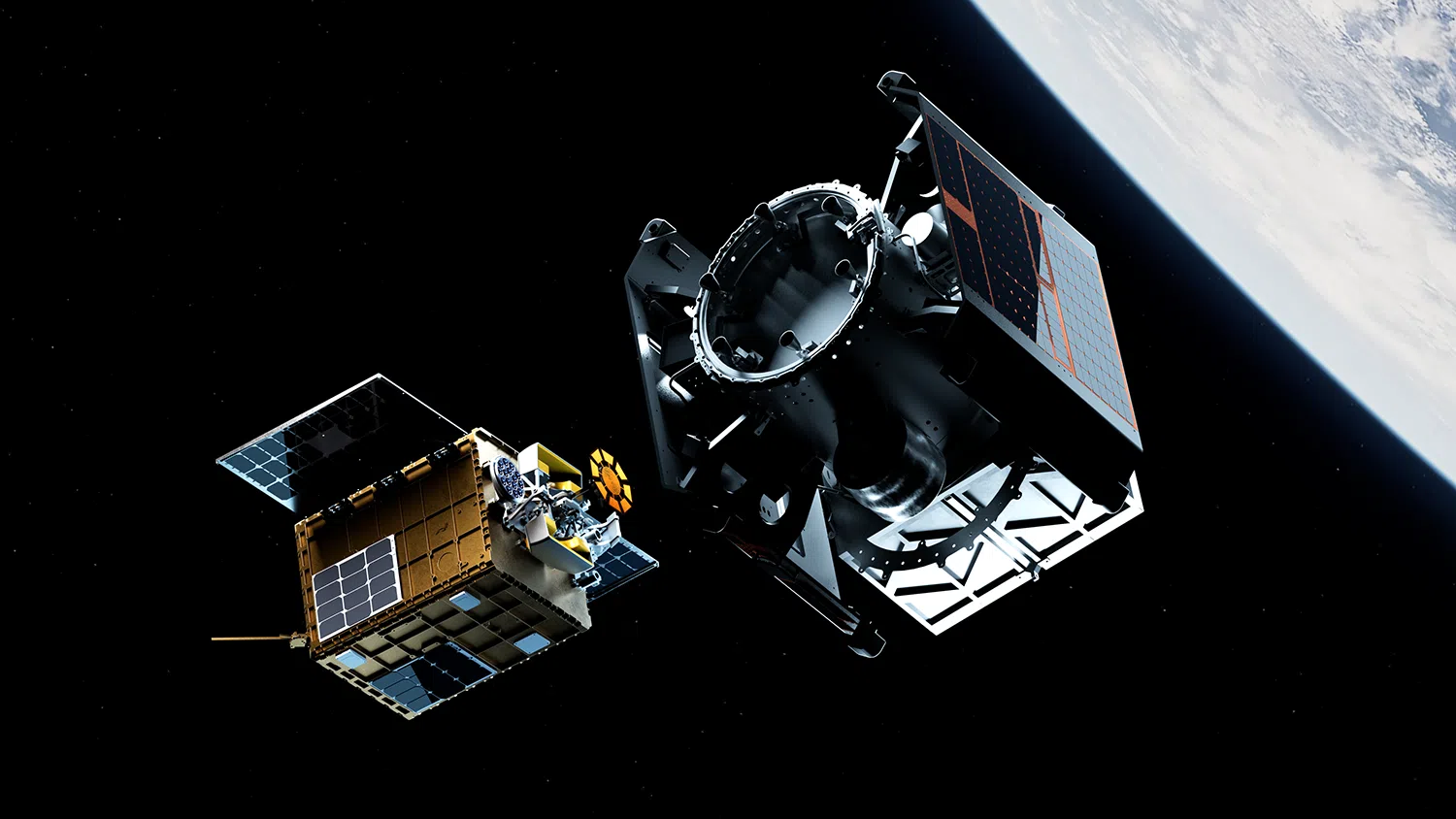
Starfish Space’s Series B, led by Point72 Ventures and reported at about $110M, is aimed at scaling production of its Otter satellite-servicing vehicles and growing the engineering team. Hiring typically concentrates in spacecraft engineering, GNC, autonomy and robotics software, mission operations, and production roles as the company moves toward a higher flight cadence.
Space Systems Command Awards the $1.843B Andromeda IDIQ
Space Systems Command awarded Andromeda contracts to 14 companies, including Anduril, Astranis, Lockheed Martin, Northrop Grumman, Sierra Space, True Anomaly, and Turion Space, under a combined $1.843B ceiling running to 2036. The vehicle buys low-cost satellites that monitor activity in geosynchronous orbit, supporting steady recruiting for payload and mission-system engineering, software, integration, test, and cleared program support.
Artemis II launched on April 1 and splashed down off San Diego on April 10, completing the first crewed flight of SLS and Orion. The mission keeps human spaceflight, avionics, and flight operations front and center, and supports continued demand in ground systems, integration, and program management across NASA and its contractors as attention shifts to the next Artemis missions.
Turion Space Raises $75M+ to Ramp Spacecraft Production
Turion Space’s Series B, led by Washington Harbour Partners, is aimed at raising production from about 8 to about 40 spacecraft per year and expanding its DROID orbital reconnaissance missions. A fivefold production ramp is a direct indicator of hiring in manufacturing, integration and test, quality, and spacecraft systems engineering.
FCC Authorizes AST SpaceMobile’s 248-Satellite System
On April 21, the FCC authorized AST SpaceMobile’s 248-satellite constellation for direct-to-phone broadband, with milestones of 124 satellites by 2030 and all 248 by 2033. Approvals at this scale create real workload across satellite manufacturing, RF and spectrum engineering, network operations, and program execution.
Portal Space Systems Scales Up in Bothell, Washington
Portal’s $50M Series A comes with a specific expansion plan: a 52,000 sq. ft. manufacturing facility in Bothell and growth from about 40 to about 100 employees. The company is building its highly maneuverable Starburst and Supernova spacecraft, a direct signal for near-term hiring across manufacturing, production engineering, propulsion, and spacecraft systems.
True Anomaly (United States) – Series D, $650M (late April), including $50M in debt. Funds faster delivery of its Jackal autonomous spacecraft and space-security systems. Source.
Starfish Space (United States) – Series B, over $100M (April 7). Scales production of Otter servicing vehicles and the engineering team. Source.
Turion Space (United States) – Series B, $75M+ (April). Supports a production ramp from about 8 to about 40 spacecraft per year. Source.
Dahang Yueqian Technology (China) – Series A, RMB 500M (~$70M) (April 29). Funds the first flight of the reusable Yueqian-1 rocket and a 100-ton methane-oxygen engine. Source.
Portal Space Systems (United States) – Series A, $50M (April 9). Builds out a 52,000 sq. ft. Bothell facility and grows the team toward about 100 employees. Source.
PLD Space (Spain / Europe) – Venture debt from the European Investment Bank, €30M (April 7). Supports final development and production scale-up of the MIURA 5 launcher, following March’s €180M Series C. Source.
Univity (France / Europe) – Series A, €27M (April 23). Completes a very-low-orbit 5G demonstration and builds a satellite internet offer for telecom operators. Source.
ATMOS Space Cargo (Germany / Europe) – Series A, €25.7M (April 22). Funds a fleet of PHOENIX 2 return capsules, a government division, and next-generation PHOENIX 3. Source.
Intergravity (South Korea) – Pre-Series A, KRW 8B (~$5.5M) (April 14). Develops the iGRVT-50 orbital transfer vehicle and an in-space manufacturing platform. Source.
New Space Intelligence (Japan) – Series A, ¥430M (~$2.8M) (April 8). Expands its satellite-data platform, hiring, and overseas reach. Source.
Xovian Aerospace (India) – Venture round, $2M (April). Supports AI-enabled RF satellites for tracking dark ships and aircraft. Source.
Orbital Chenguang (China) – Pre-Series A1, amount undisclosed (April 20), alongside about RMB 57.7B (~$8B) in non-binding bank credit intentions. Targets satellites for space-based data centers. Source.
Contracts and Grants
U.S. Space Force / Space Systems Command → 14 companies (Andromeda IDIQ) – up to $1.843B combined ceiling (April 7). Low-cost satellites to monitor activity in geosynchronous orbit, with orders running through 2036. Read more.
U.S. Space Force / Space Systems Command → L3Harris Technologies (U.S.) – $150M (April 7). Sustainment and modernization of space-surveillance ground systems under MOSSAIC. Read more.
Launch and Regulation
NASA / Artemis II (United States) – Crewed lunar flyby, launched April 1 and splashed down April 10. Supports sustained demand across human-spaceflight systems, flight operations, and ground infrastructure. Read more.
Egypt, Kenya, Uganda / ClimCam – The first jointly built African Earth-observation payload launched to the ISS aboard Cygnus XL NG-24 on April 11, a narrower signal centered on payload integration and climate-data workflows. Read more.
Blue Origin / New Glenn NG-3 (United States) – Upper-stage underperformance on April 19 left AST SpaceMobile’s BlueBird 7 in an unrecoverable orbit, prompting an FAA-overseen mishap investigation. Read more.
FCC / AST SpaceMobile (United States) – Authorization of a 248-satellite NGSO system with supplemental coverage from space (April 21), supporting direct-to-phone service with U.S. carriers. Read more.
FAA (United States) – Policy statement on launch and reentry licensing user fees (April 22), introducing per-launch fees starting at $0.25/lb with a $30,000 cap in 2026. Read more.
FCC (United States) – FCC 26-26 adopted (April 30), replacing legacy EPFD limits with performance-based protection criteria for GSO systems and opening more capacity for satellite broadband. Read more.
Roles in Demand, April 2026
Engineering
Spacecraft systems engineering
GNC (guidance, navigation & control)
Autonomy engineering
RF & spectrum engineering
Propulsion engineering
Integration & test engineering
Manufacturing & Operations
Spacecraft manufacturing
Production engineering
Mission operations
Ground systems
Network operations
Test & quality
Software & Analysis
Mission software
Autonomy software
Robotics software
Space domain awareness analysis
Earth observation data workflows
Compliance & Assurance
Spectrum & licensing compliance
Launch mishap investigation & reliability
Mission assurance
Security / cleared program support
Key Regions
United States
Bothell, Washington (U.S.)
Florida (U.S.)
Spain
France
Germany
China
Japan
South Korea
India
Ready to take the next step?
Whether you're hiring or looking, we connect you with the space industry.
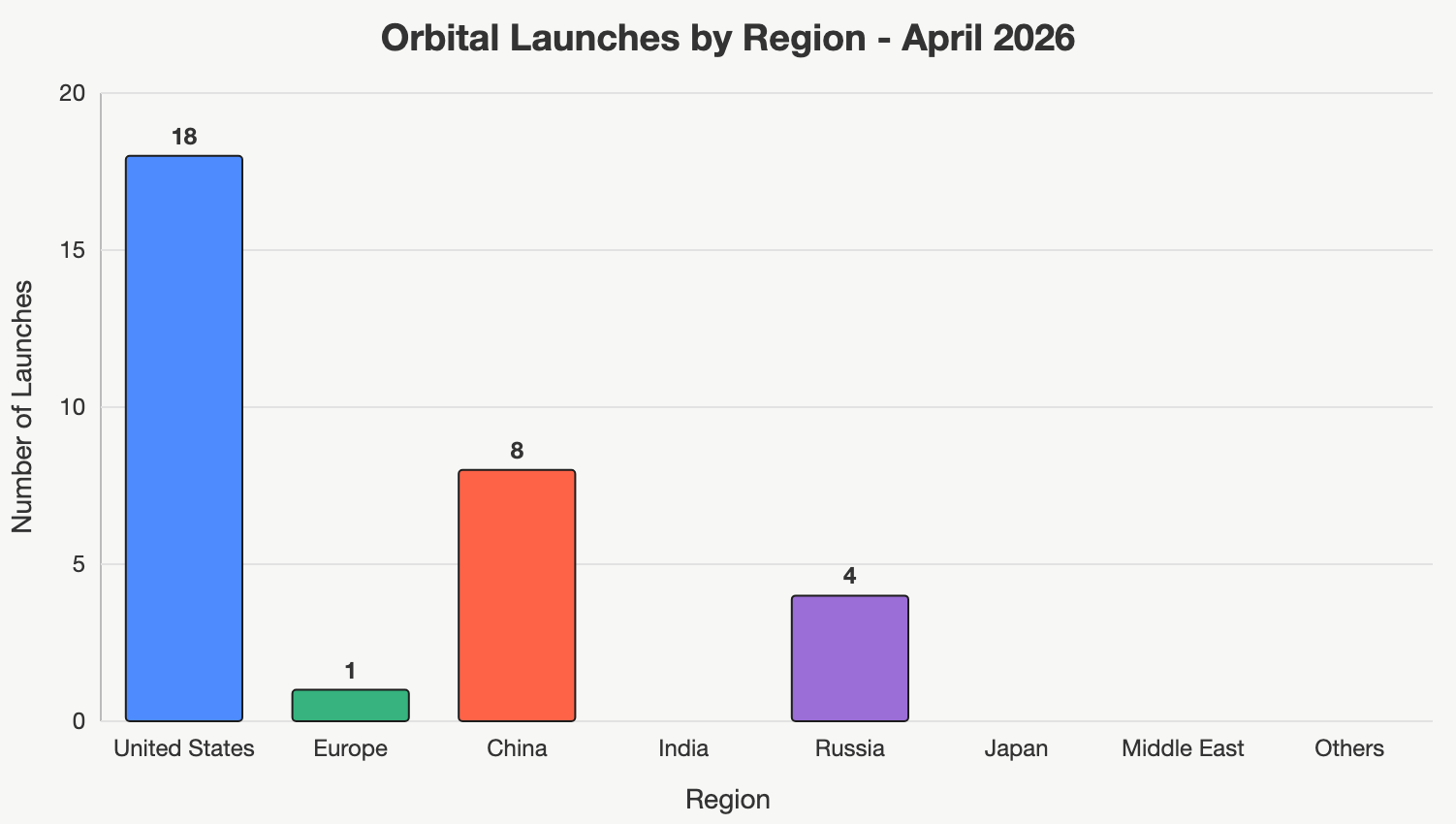
This bar chart visualizes orbital launch activity for April 2026, with a total of 31 attempts
(29 successes, 2 failures). The United States led with 18 launches, including the crewed
Artemis II mission on SLS (April 1), 11 Falcon 9 flights (9 Starlink batches, Cygnus NG-24, and
GPS III-10), a Falcon Heavy with ViaSat-3 F3, two Atlas V launches for Amazon Leo, a Minotaur IV,
and a Rocket Lab Electron; Blue Origin's New Glenn NG-3 (BlueBird 7) failed on April 19. China
contributed 8 launches across the Long March series, Jielong-3, and Kinetica-1, while Space
Pioneer's Tianlong-3 failed on its first flight. Russia flew 4 successful missions, including
Progress MS-34 to the ISS. Europe recorded 1 launch, an Ariane 64 carrying 32 Amazon Leo
satellites. India, Japan, and the Middle East had no orbital launches this month.
Methodology and Sources
This report compiles April 2026 announcements from
Payload,
European Spaceflight,
SpaceNews,
FCC,
FAA, and
ESA STAR.
Events are scored on a five-point scale for expected hiring impact within 3 to 12 months.
Rankings weigh funding size, contract value, immediacy, and regional scope.
If you notice any discrepancies or missing information, please contact us at
team@spacejobsearch.com.

 Credit: Starfish Space